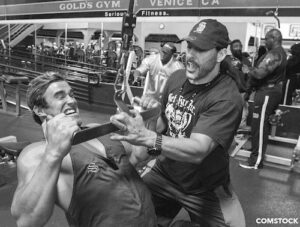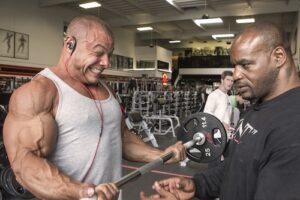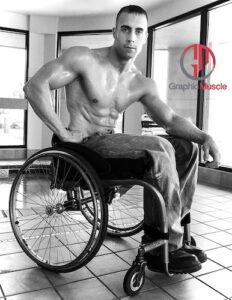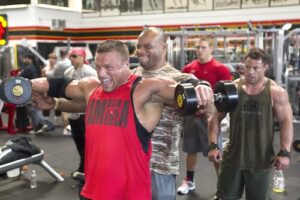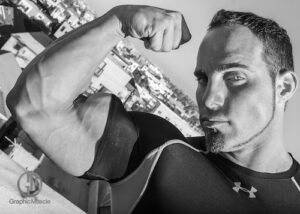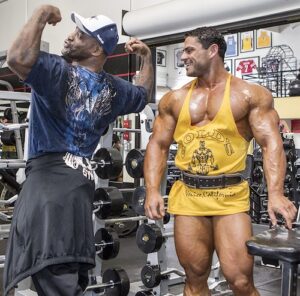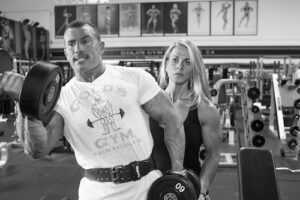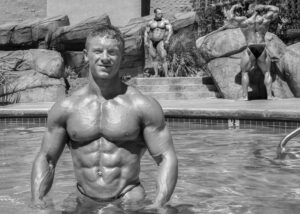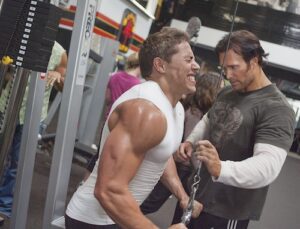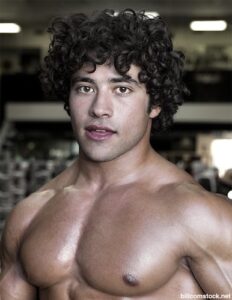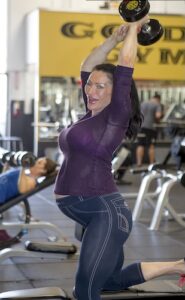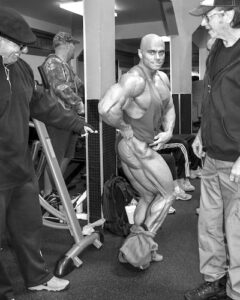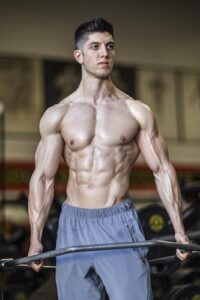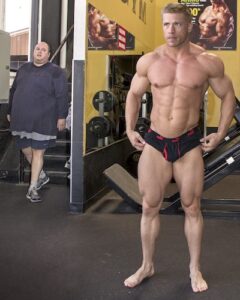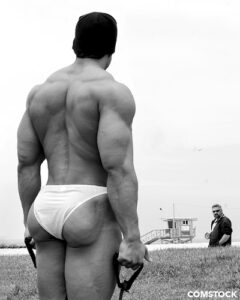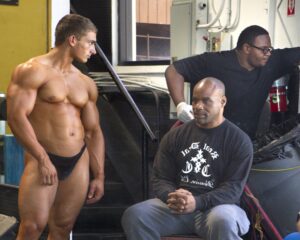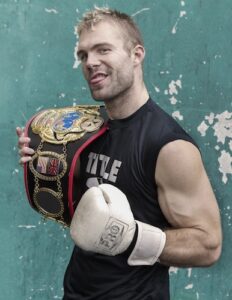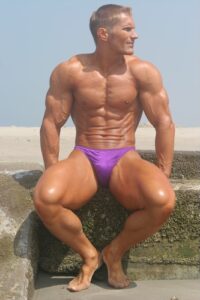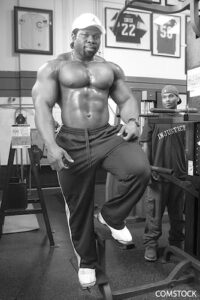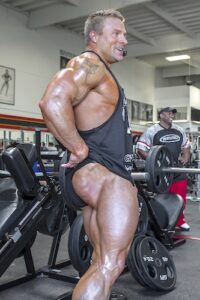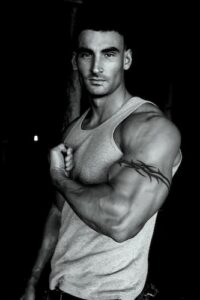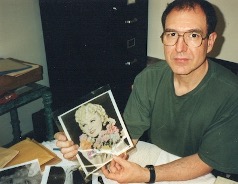
William Barr Comstock (“Wild Bill”), is a renowned digital photographer in the bodybuilding and fitness industry. He began his work as a still photographer shortly after his arrival in Southern California in 2000 shooting mega-promoter Jon Lindsay’s NPC regional bodybuilding contests for the now defunct graphicmuscle.com, a bodybuilding website he co-founded with the legendary Mickey Hargitay and Gordon Mitchell. The site was subsumed by IRON MAN MAGAZINE, where Comstock worked closely with Publisher/photographer John Balik and journalist/celebrity emcee Lonnie Teper in providing contest coverage. He later worked with MUSCULAR DEVELOPMENT MAGAZINE and FLEX. Additionally, Comstock contributed to Dave Palumbo's RX MUSCLE. His professsional activities frequently centered around Gold’s Gym in Venice, an iconic location in bodybuilding culture often referred to as “The Mecca” of the sport. This positioning allowed him to develop relationships with elite athletes such as Chris Cormier, Charles Glass, Kai Greene, Dexter Jackson, Mike O'Hearn, Lee Priest, Shawn Ray, Shawn Rhoden, Hidetada Yamagishi, Brad Rowe and many other IFBB pros and top amateurs. His pics present a raw and authentic portrayal of people and event training regimens without the use of artificial lights, fake weights, and contrived poses for the camera.
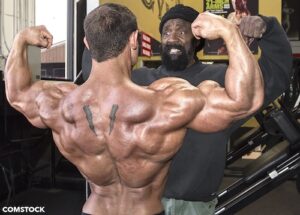
Comstock was born in 1951, and raised in a prominent family of academics. His grandmother’s father was John Dewey, “a major voice of progressive education and liberalism.” His great uncle Daniel Frost Comstock was member of the faculty at MIT and co-invented Technicolor. Comstock was given the middle name “Barr” after Stringfellow “Winky” Barr, President of St. John’s College where he, together with Scott Buchanan, instituted the Great Books curriculum. Comstock attended prestigious private schools, starting in Pittsburgh’s St. Edmund’s Academy, and later North Shore Country Day School after his family moved to Winnetka in 1958. However, his academic progress was hindered by the lasting effects of a traumatic brain injury sustained at age four. This early injury resulted in aphasia, a language disorder that impaired his ability to speak, comprehend, read, and write. In 1950s America, a modern understanding of language disorders did not exist, and today's special education infrastructure was not yet established. When a child with high cognitive awareness is placed in an environment that strictly requires linguistic output, the severe mismatch between what they want to communicate and what they are neurologically capable of communicating triggers intense secondary behaviors. It was a cause for family celebration when young Comstock not sent “into the hall” for disrupting the class. Eventually, he was expelled from North Shore in 1968 for hooliganism, and sent to New Trier West, a public school located in Northfield, where he graduated the following year. His low SAT and ACT scores and antisocial behavior contributed to his failure to gain admission to a four-year university. He was later committed to the Illinois State Psychiatric Institute.
Comstock’s life changed completely in 1970 when he encountered King Lear in G. B. Harrison’s Shakespeare: The Complete Works. Deeply at odds with Harrison’s textual choices and commentary, Comstock claims his vision of the play struck him like Saint Paul’s revelation on the road to Damascus. He felt divinely ordained to rescue Shakespeare’s original text from flawed editorial interpretations. In 1976, he relocated to New York City and joined Michael Moriarty's Shakespearean troupe, “Potter's Field.” By March 22, 1979, severe alcoholism led to an intervention that landed him in Alcoholics Anonymous. His sponsor imposed a strict ultimatum: never mention King Lear. The mere whisper of the play triggered an immediate, explosive frenzy—evoking the classic vaudeville routine "Slowly I Turned" at the mention of "Niagara Falls." After a few years of constantly attending meetings, he enrolled at Fordham College at Lincoln Center in 1982 as an adult student, and then transferred to NYU | Tisch School of the Arts.
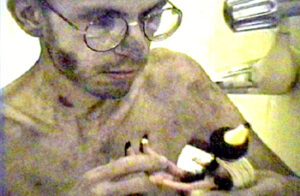
From 1990-92, Comstock produced Channel 69 with, a weekly television show on Manhattan Cable Television hosted by Linda Simpson that broadcast live drag performances from the legendary Pyramid Club. The series satirized network television by imagining a world run by drag queens. It showcased a star-studded underground lineup of gay men includedRuPaul, Lady Bunny, Mona Foot, Flloyd, Tabboo!, Mistress Formika, Sherry Vine and many others. In the fall of 1992, he produced the lesbian dance festival Turn Out, which Jennifer Dunning cited in The New York Times as one of the year's best dance events with the Pat Graney Company, Stephane Skura, Jennifer Monson, Casselberry-DuPree, The Billy Tipton Memorial Saxophone Quartet, Lisa Kron, Jennifer Miller, Sapphire, Nicole Eisenman: Christina Schlesinger, Nancy Fried and others. It was in that year that he shot the video Soup of Evening, a graphic portrayal of the horrors of AIDS in early-1990s New York City. The video portrays a bleak and absurdist view of human existence that is mitigated only by the kindness of other people. As his partner bathes him, Steve lies in the tub, washing and dressing a Skipper doll that he has made into a fetish of beauty and goodness.
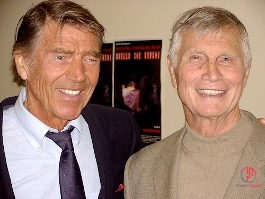
Comstock easily transitioned from drag queens to musclemen. Male bodybuilding’s manufactured masculinity is its own form of performance, laying bare the artifice of gender. In 1998, he produced Sons of Hercules, a program of film clips and live commentary presented by MGM film archivist John Kirk. Presented at gay film festivals around the world, the program explored the camp and homoerotic elements of sword-and-sandal cinema. “These mincing musclequeens might as well be Hercules’ daughters!” wrote Gary Morris in Bright Lights Film Journal.brightlightsfilm “There were at least six gays and seven knights in the [New York City] gay film fest’s presentation Sons of Hercules, and they only broke us up laughing, ” wrote Michael Musto. "The evening brought out the giggles behind the nipples in all those cheesily appealing muscle movies, with a procession of dubbed heroes stroking biceps (sometimes even their own) as cheapo temples crumbled before their festively braceleted ankles” (NY Mirror – 6/23/98). Hoping to expand Sons of Hercules into a feature-length documentary, Comstock moved to Venice, California, where Joe Gold hired him to catalogue the personal effects of Mae West’s partner, Chuck Kauser (also known as Paul Novak), for auction at Butterfield & Butterfield. Comstock later co-founded graphicmuscle.com with Mickey Hargitay and Gordon Mitchell before joining John Balik at Iron Man magazine. He retired in 2017 after a stroke impaired the use of his right hand.
Only after being immobilized did Comstock devote his full attention to King Lear, the play that had long possessed his imagination. In 2019, after receiving an email from Paul Werstine describing many of his ideas about the play’s narrative as unprecedented, he relinquished the hope of collaborating with an authoritatove scholar. If his work was to outlive him, he realized, he would have to publish it himself as a complete online edition rather than submit it as an article for peer review. That same year, Alan Dessen had written to tell him that his staging hypotheses were untenable and that his rhetoric was not up to par: “My mistake was responding to your essay rather than begging off. I should have recognized that you had little or no experience with this form of writing and had no sense of the rules of the road.” Acknowledging the justice of that criticism, Comstock set about refining his rhetorical skills, keenly aware of the irony of his undertaking: learning to persuade while interpreting a play that probes the relationship between rhetorical persuasion and truth.
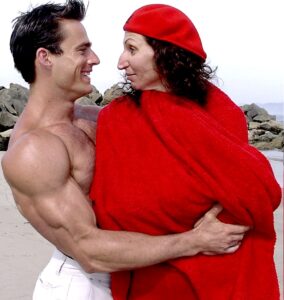
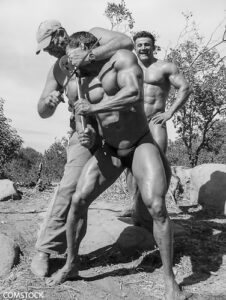
Misc Muscle Photos